Healthy Food Guide magazine subscription
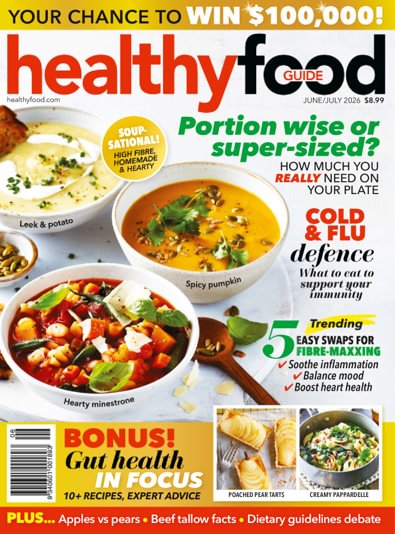
Cover
Price: $8.99
you save up to 4%
Nourishing, can-do recipes, expert health advice, practical ideas and shopping tips for healthy options, juicy facts and an easy-to-follow meal planner – making good food choices just became that much easier.
Read more
Deliver to:
Earn up to 260 isubscribe Rewards Points, that's 5 points per $1 spent.
RRP
$53.94
$52.00
SAVE 4%
CHANCE TO WIN
Earn up to 445 isubscribe Rewards Points, that's 5 points per $1 spent.
Digital subscriptions are available for this title. Digital Subscriptions are supplied by Zinio, who will deliver the digital editions direct to your inbox - you can access them directly through your web browser or download the Zinio app on your mobile device.
VIEW DIGITAL SUBSCRIPTIONS
Chance To Win With Healthy Food Guide Magazine
Chance To Win
Subscribe to Healthy Food Guide Magazine for 12 months for your Chance To Win Chance to win 1 of 3 copies of Anti-Inflammation Diet!
Australian Healthy Food Guide makes it easy for you to make healthy eating choices every day without having to compromise on taste, spend hours in the kitchen, or more money at the checkout.
Inside every issue our expert dietitians and nutritionists share with you the latest research, facts and myth-busters and informative articles with practical, seasonal advice.
You’ll also find a month’s worth of healthy, nourishing recipes - each with a complete nutritional analysis, quick tips and smart ideas to help you make good food choices at the supermarket - and to top it off, a no-fuss weekly meal-planner to really keep things simple. Too easy.
From the publisher
Healthy Food Guide is a monthly magazine that makes it easy for anyone to make healthy eating choices. Every issue contains practical advice from expert dietitians and nutritionists, dozens of tips and ideas to help consumers choose the right products at the supermarket, and a month’s worth of healthy recipes, all with a complete nutritional analysis showing kilojoules, fat, protein, carbohydrate, sodium and more.
Healthy Food Guide shows how to eat well every single day – without having to compromise on taste, spend hours in the kitchen, or more money at the checkout.
All prices for magazine subscriptions listed on isubscribe include delivery.
Your subscription will begin with the next available issue and in most cases, your magazine will be in your hands before it goes on sale in the shops! Due to publishing cycles and potential delays with Australia Post, please allow up to 6-9 weeks for your first delivery to arrive.
Healthy Food Guide is published by
Next Media,
who handle delivery and stipulate the lead time shown above.
Explore more titles from this publisher here.
SPECIAL OFFER TERMS & CONDITIONS
Competition open to Aust and NZ residents subscribing in print to Healthy Food Guide for 1 year or more between 00:01 AEST 01/06/26 and 23:59 AEST 09/07/26. Three (3) subscribers will each receive a copy of Anti-Inflammation Diet valued at $14.95. Total prize pool valued at $44.85. The winners will be drawn at the Promoter’s premises on 14/07/26. The Promoter is nextmedia P/L, Level 12, 111 Pacific Hwy, North Sydney NSW 2060 ABN 84 128 805 970.
In This Issue:
Welcome
This time of year can be a slog. The days are short, the temperatures are cold and summer feels like a distant memory. Staying active or whipping up a healthy meal can be more of challenge. But it’s also the time of year when sticking to a healthy routine really pays off, keeping our immune system in tip top shape and mood and energy levels up.
To make it all a bit easier, I have a repertoire of tasty winter recipes on rotation. Vegetarian lasagne, aromatic curries, hearty soups, slow-cooked casseroles and warm roasted veg salads all make the evenings a more cheerful affair. There’s nothing quite like the feeling of bundling up and going for a winter wander out in the elements, then coming home to a cosy house…
Why you can trust healthy food
Healthy Food Guide (HFG) magazine is your complete guide to healthy eating. Our recipes use easy-to-find, affordable ingredients. Cook with HFG and you’ll always enjoy a nutritious meal.
You can trust our advice. All our health information is supported by solid scientific evidence, not media fanfare. We smooth out any confusion caused by ‘pseudoscientists’.
We give unbiased opinions and are not affiliated with any food manufacturers. All branded food in HFG has been approved by our dietitians.Advertisers cannot influence editorial content.
Dietitians review all our articles so they’re always accurate with up-to-date information. A full list of references is also available on request.
Every recipe in Healthy Food Guide is healthy
Our recipe writers work with qualified dietitians to develop all our meals. A nutritional analysis is provided for every…
Ask the expert… Min Saw
Q&A
I’ve been diagnosed with Hashimoto’s disease and have been told to try a few diets, like avoiding histamines, FODMAPS, gluten and nightshades. That seems like a lot of food to cut out. Can you please give me some advice on where to begin? Deb, Palmerston North
While we can’t give individual health advice at Healthy Food Guide , there are some general comments we can make. There’s so much misinformation out there about thyroid health, largely because the research isn’t always strong or consistent. That’s why you’ll see people recommending cutting out specific food groups or nutrients – but don’t worry too much, restriction is often unnecessary (and can make eating stressful and nutritionally inadequate).
For most people with Hashimoto’s, medication like levothyroxine is essential. Diet isn’t a replacement…
news bites
Cold reality
Freezing food comes in handy for avoiding food waste, meal prepping or storing leftovers, but be warned, it doesn’t necessarily make food safe. If bacteria are present in food before it goes into the freezer, they're likely still there when it comes back out, just put on hold for a while, UNSW experts warn. They advise taking steps to freeze and thaw food safely including cooling as quickly as possible after cooking, dividing food into small, sealed containers so they freeze and defrost faster, and thawing food in the fridge or microwave – not the benchtop. UNSW
SUPPORTIVE SCHOOLS
School isn’t just a place to learn, it plays a critical role in teens’ well-being, NZ research shows. According to a study, 15-year-olds who feel satisfied with school and…
Get chopping to cut dementia risk
We know it’s good to cook your own meals, but here’s a benefit you might not have thought of – it may help prevent dementia.
Researchers in Japan found that cooking a meal from scratch at home was associated with a 23 per cent lower dementia risk for men and 27 per cent for women. But that increased to up to a 67 per cent reduction in people with few cooking skills.
Cooking at home encourages healthier eating habits, including more fruit and veg, and less consumption of ultra-processed food. It also requires physical activity, such as grocery shopping and preparing meals, which are valuable forms of exercise for older adults, especially after retirement, the researchers said. And the complex cognitive tasks involved – like planning and following recipes –…
Fibre 101 HOW TO MAXIMISE YOUR DAILY FIBRE
Our protein obsession is so 2025. Fibre is finally getting the attention it deserves, with people all over social media trying to figure out how to get more of this disease-fighting, gut-health promoting superstar into their day. Here are the basics you need to know to hit your daily targets.
WHY FIBRE IS WORTH MAXIMISING
Fibre, as boring and brown as it sounds, is a star when it comes to helping us maximise our health. It is a type of carbohydrate that can’t be digested by the body, which is why it’s sometimes called ‘roughage’. Ensuring we get enough roughage in our diet can reduce our risk of being overweight, or getting type 2 diabetes, heart disease and certain types of cancer. And rather than cutting down on what we…
What do US dietary guideline changes mean for us?
Kathleen Alleaume is a nutritionist, exercise physiologist and founder of The Right Balance. Connect with her at www.therightbalance.com.au or on Instagram @therightbalance_
Eearly in 2026, the United States released its 2025–2030 Dietary Guidelines for Americans, placing a fresh emphasis on so-called ‘real food’ and flipping the food pyramid on its head. The updated advice encourages people to prioritise protein at every meal, include full-fat dairy and limit ultra-processed foods.
The response has been mixed. Some see the changes as a long-overdue move toward more practical, whole-food based eating. Others argue the messaging is confusing and even potentially misleading.
MUCH OF THE CORE ADVICE UNCHANGED
At its core, the guidance remains familiar: eat plenty of fruits, vegetables and whole grains, include a variety of protein, and limit added sugars, salt and…
How
DIET AND LIFESTYLE
can boost your immune system this
COLD AND FLU SEASON
Every day we are exposed to a wide array of potentially harmful microorganisms – such as colds, the flu and even COVID. But our immune system – a network of intricate pathways within our body – helps protect us against these microorganisms and other potential diseases. Essentially, it recognises foreign invaders, such as viruses and bacteria, and takes immediate action to defend us.
Humans have two types of immunity: innate and adaptive. Innate immunity is the body’s first line of defence, primarily consisting of physical barriers (such as skin), and secretions – including mucus, stomach acid and enzymes in saliva and sweat which prevent microorganisms getting inside the body. It also consists of cells that attack all foreign invaders entering the body.
Adaptive immunity is a system that learns to…
How to be
PORTION WISE
If someone asked you what a healthy sized portion of lasagne was, would you know? What about a serving of rice? Or a bowl of breakfast cereal? If you haven’t got a clue, you’re not to blame. Research shows that the portion sizes stated on packaging, and even those recommended by health organisations, can vary dramatically for foods like muesli, granola, fish, meat, rice, pasta and potatoes. As a result, many of us are completely baffled about just what counts as a healthy serving of food.
And a lack of consistency in recommended serving sizes isn’t the only problem. Studies confirm that portion and serving sizes, particularly for many discretionary foods, have increased since the 1990s, and evidence shows people are more likely to eat more if portion sizes are…
BEEF TALLOW
Hype or healthy?
Beef tallow is made by gently heating raw animal fat for several hours, then filtering it until only pure fat remains. The end result is a creamy white or pale yellow substance that's solid at room temperature. It’s mostly saturated fat, and was a staple cooking fat before industrial seed oils became widely used.
These days you’ll often hear that it’s less processed, more natural, better for high-heat cooking, and even great for your skin. Sounds impressive - but how much of this actually holds up to scientific scrutiny?
CLAIM: BEEF TALLOW IS SAFER FOR COOKING BECAUSE IT’S LESS PROCESSED AND HAS A HIGHER SMOKE POINT
It’s true that beef tallow doesn’t go through industrial solvent extraction, and its high saturated fat content gives it a naturally higher smoke point.…
Prev
Next
https://www.isubscribe.com.au/healthy-food-guide-magazine-subscription.cfm
16524
Healthy Food Guide
https://www.isubscribe.com.au/images/covers/au/779/16524/square/HealthyFoodGuide16202623457.jpg
20.00
AUD
InStock
/Magazines/Food & Drink/Food
Nourishing, can-do recipes, expert health advice, practical ideas and shopping tips for healthy options, juicy facts and an easy-to-follow meal planner – making good food choices just became that much easier.
20.00