New Scientist Australian Edition digital subscription
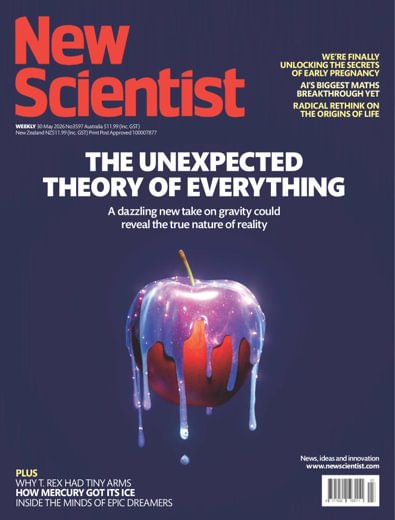
Current Issue: 30 May 2026
Single Issue
Price: $7.99
you save up to 40%
Earn up to 1200 isubscribe Rewards Points, that's 5 points per $1 spent.
This is a digital subscription supplied by Zinio, who will deliver the digital editions direct to your inbox - you can access them directly through your web browser or download the Zinio app on your mobile device. Which devices can I read on?
For people who ask why
New Scientist covers the latest developments in science and technology that will impact your world. New Scientist employs and commissions the best writers in their fields from all over the world. Our editorial team provide cutting-edge news, award-winning features and reports, written in concise and clear language that puts discoveries and advances in the context of everyday life today and in the future.
In This Issue:
A communal broth
THE phrase “survival of the fittest” is so closely associated with Darwinism that many people assume Charles Darwin himself wrote it. He didn’t – it was foisted on him by a contemporary, Herbert Spencer. It is true, however, that in On the Origin of Species, Darwin emphasised competition as the dominant process behind life – but, like all of us, he was shaped by his environment.
Darwin presented an account of nature as a competitive struggle not so much because that is how he saw it, but because he sought to deliver in his book what he thought people wanted to hear. This was a time of empire, and also of the industrial revolution, when society was gripped by the ideas of Thomas Malthus and Thomas Hobbes; people were thought…
Alzheimer’s tests are failing women
WOMEN tend to have more robust verbal memories than men, which can mask signs of early Alzheimer’s disease. This means that commonly used memory tests may fail to pick up on the condition in women, delaying their diagnosis and treatment, according to a new study.
“We are starting to recognise that gender differences in Alzheimer’s is a big issue,” says Ralph Martins at Edith Cowan University in Perth, Australia, who wasn’t involved in the research.
Sasha Novozhilova at McGill University in Montreal and her colleagues analysed data from two large, long-term studies that conducted regular cognitive testing and brain imaging of older adults in the US and Canada, some of whom developed Alzheimer’s disease.
The participants’ cognition was assessed by getting them to learn a list of 15 words that…
mRNA vaccine may protect against multiple Ebola viruses at once
A NEW mRNA vaccine has been developed that may provide long-term protection against the deadliest viruses in the Ebola family – including the Bundibugyo strain currently spreading in two African countries.
As New Scientist went to press, there had been more than 900 suspected cases in the Democratic Republic of the Congo and seven confirmed cases in Uganda. The World Health Organization has declared the outbreak a public health emergency of international concern.
Bundibugyo virus is a member of a group of pathogens known as orthoebolaviruses, which also includes two other forms of Ebola, Zaire virus – the most common kind – and Sudan virus. They can all cause severe disease in humans.
Until now, Bundibugyo outbreaks have been rare compared with those of Zaire, which infected over 28,000 people…
Plasma beams could help astronauts clean smelly laundry
ASTRONAUTS in space can’t do laundry – but that may be about to change.
On the International Space Station, astronauts tend to wear the same clothes for days and then pack them up to be thrown towards Earth, where they burn up in the atmosphere. That’s all well and good for missions lasting a few weeks or even months, but it isn’t viable for longer trips that aren’t regularly resupplied from Earth.
Now, Gabe Xu at the University of Alabama in Huntsville and Chelsi Cassilly at NASA’s Marshall Space Flight Center in Alabama have developed a sort of “laundry gun” that can be used to blast fabrics with cold plasma, killing off the microbes that cause unpleasant odours. Xu presented this work at the Astrobiology Science Conference in Wisconsin on 21…
AI’s biggest maths breakthrough
AN 80-YEAR-OLD maths conjecture that has eluded the world’s greatest mathematicians has been solved by an artificial intelligence model built by OpenAI. The result has stunned experts and is being hailed as a seismic moment for AI’s mathematical ability.
“This is a problem that I didn’t expect to see solved in my lifetime,” says Misha Rudnev at the University of Bristol, UK. “It’s absolutely a bomb.”
Tim Gowers at the University of Cambridge wrote that the solution is “a milestone in AI mathematics” in a blog post accompanying the work. “If a human had written the paper and submitted it to the Annals of Mathematics and I had been asked for a quick opinion, I would have recommended acceptance without any hesitation. No previous AI-generated proof has come close to…
Epic dreaming is leaving people exhausted and distressed
IMAGINE regularly waking up exhausted, not because you didn’t sleep, but because you seemingly spent the entire night immersed in incessant dreams. For people who experience such “epic dreaming”, the effects can be severe, often impacting their work and day-to-day lives.
“These vivid experiences linger in my mind, drain my energy and create lasting fatigue,” said one such epic dreamer.
This woman, identified as 38-year-old Madame R., is one of four epic dreamers who have been assessed at two centres in France. Though scientific descriptions of epic dreams date back more than 20 years, the four detailed case studies support the idea that it should be recognised as a distinct sleep disorder, according to the researchers, who included Pierre Geoffroy at Paris City University.
During her assessment, Madame R said…
Can Colossal bring back the moa?
THE extinct, flightless moas of New Zealand stood over 3 metres tall, weighing over 200 kilograms. Their eggs were larger than those of any living bird – a problem for Colossal Biosciences, which is aiming to bring them back to life. Now, the company claims to have developed an artificial eggshell consisting of a lattice supporting a transparent silicone membrane, which it says will enable it to create eggs as large as those of the moa.
Is this the first-ever artificial bird egg?
Colossal does use the term “artificial egg” in its press release, but it is really just an artificial eggshell. Either way, it isn’t a first – in fact, it is possible to remove chicken eggs from their shells and hatch them from anything from plastic cups to…
Wind-assisted vessels could eliminate shipping emissions
THE shipping industry is responsible for around 3 per cent of carbon dioxide emissions – but if wind-assisted cargo ships chose routes based entirely on where the winds are better, their fuel use could be cut in half or even completely eliminated.
There is growing interest among shipping companies in exploiting wind power, as it can help cut fuel costs. Some of them are building ships with conventional sails from scratch. Meanwhile, others are adding various kinds of automated sails to existing vessels.
The technologies include rigid sails resembling aircraft wings, Flettner rotors consisting of rotating cylinders, suction sails that suck in air to maximise lift and even giant kites similar to those used by kitesurfers.
“There is a whole spectrum of wind propulsion vessels,” says Gavin Allwright at the…
Flotation tanks used to help combat PTSD
A SHIPPING container holding three mobile flotation tanks is en route to Maui, Hawaii, to tackle a mental health crisis caused by one of the deadliest wildfires in US history.
In August 2023, a series of wildfires erupted on Maui, the worst of which killed 102 people. In the years since, risks of depression and anxiety have been higher within wildfire burn zones, and there are fears of an unfolding epidemic of posttraumatic stress disorder (PTSD).
“Maui does not have an infrastructure to deal with a mental health crisis of this magnitude,” says Justin Feinstein, a clinical neuropsychologist who set up the non-profit Float Research Collective.
At this month’s Embodied Minds Summit in Los Angeles, Feinstein announced that the float units would be available for free sessions for first responders…
Molecule with ‘wings’ may unlock quantum realm
A LARGE, cold molecule that resembles a butterfly, with “wings” made from electrons, has been made for the first time, completing the search for a “zoo” of similar molecules. The result could provide a gateway to new parts of the quantum realm.
Herwig Ott at RPTU University Kaiserslautern-Landau in Germany and his colleagues made the molecule by using lasers and electromagnetic forces to cool rubidium atoms to a few millionths of a degree above absolute zero. They then used lasers again to make some atoms very large by pushing their outermost electron very far from their nuclei. The quantum properties of atoms that have been cooled and enlarged in this way can be precisely manipulated with lasers, which the team leveraged to move a giant atom’s electron towards a normal-sized…
Prev
Next
https://www.isubscribe.com.au/new-scientist-australian-edition-digital-subscription.cfm
35955
New Scientist Australian Edition
https://www.isubscribe.com.au/images/covers/au/5254/35955/square/NewScientistAustralianEdition16202622838.jpg
7.99
AUD
InStock
/Digital/Science & Nature/Environment
For people who ask why
7.99