New Scientist Australian Edition digital subscription
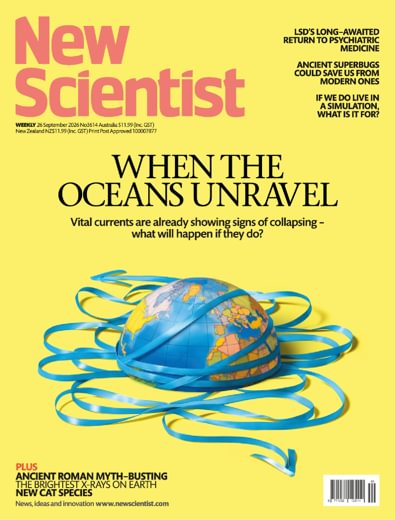
Current Issue: 26 September 2026
Single Issue
Price: $7.99
you save up to 40%
Earn up to 1200 isubscribe Rewards Points, that's 5 points per $1 spent.
This is a digital subscription supplied by Zinio, who will deliver the digital editions direct to your inbox - you can access them directly through your web browser or download the Zinio app on your mobile device. Which devices can I read on?
For people who ask why
New Scientist covers the latest developments in science and technology that will impact your world. New Scientist employs and commissions the best writers in their fields from all over the world. Our editorial team provide cutting-edge news, award-winning features and reports, written in concise and clear language that puts discoveries and advances in the context of everyday life today and in the future.
Be the first!
& get $5 off your next purchase
Be the first person to tell us what you think about New Scientist Australian Edition and you'll save $5 on your next purchase!
In This Issue:
Tipping point
MOST climate impacts are like repeatedly shooting ourselves in the foot: we keep emitting greenhouse gases, the planet warms and more heatwaves happen, and wildfires, and flooding, and drought. Science tells us that this is mechanistic: pull the trigger and you will get hurt.
But in some cases, large uncertainty remains. One particular concern is the Atlantic Meridional Overturning Circulation (AMOC), the system of currents that transport a tremendous amount of heat from the Gulf of Mexico to Europe. As ever more icebergs and meltwater from Greenland rush into the north Atlantic (see page 6), the AMOC is thought to be slowing down. Eventually it could even collapse, bringing “ice age” winters to Europe, raising sea levels in North America and disrupting vital monsoons in Africa and Asia.
Will that…
Mice given human brain organoids
TINY versions of the human cerebral cortex – a region involved in memory, movement and thinking – were implanted into mice that lacked this major brain region. Not only did the human brain organoids integrate into the mice's brains, but they also restored most of their cognition.
"The mouse is [relatively] sick without a cortex, then you transplant these organoids in, and it behaves more like the normal mouse," says Gabriel Balmus at the University of Cambridge, who wasn't involved in the research.
Sergiu Pașca at Stanford University in California and his colleagues genetically engineered mice to lack more than 90 per cent of their cortex, or about half their brain. These mice experience only some memory and movement deficits, since their brain adapts to compensate for their missing cortex,…
Fast-flowing glaciers behind ice sheet shrinkage
Climate change
MOST ice loss in Greenland and Antarctica isn’t due to melting at the surface. Instead, these ice sheets are shrinking mainly because glaciers are flowing faster into the ocean, raising the risk of feedback loops that could accelerate sea-level rise.
While rising air temperatures thaw ice at the surface, glaciers also lose ice at the coast. Relatively warm ocean water melts the glacier’s underside and icebergs calve off its tongue, drifting equatorward to melt. The quicker a glacier flows, the more ice it will lose to the sea.
The longest satellite record ever compiled shows ice loss has sped up by a factor of four since the 1980s due to global warming. It found that 84 per cent of this acceleration was caused by glacier flow and only…
Fundamental force is not so weak
ONE of the universe’s fundamental forces appears to be stronger than we thought, a finding that could lead to the discovery of new particles.
The electroweak force unifies the electromagnetic and the weak nuclear forces. Under ordinary conditions, the two forces are distinct and play a role in different processes, such as the weak force being part of radioactive decay and the electromagnetic force affecting charged objects. But at very high energies and temperatures, like in particle colliders, the two forces combine.
Alessandro Conigli at Johannes Gutenberg University Mainz in Germany and his colleagues have now calculated several properties that capture the strength of the electroweak force with unprecedented precision and found a discrepancy with past calculations.
Calculating details of nuclear forces is notoriously difficult. For decades, researchers could only…
Call to save sea life from El Niño
PROMINENT scientists have called for “emergency” interventions to protect marine life, as the strongest-ever El Niño heats the ocean to unprecedented levels, including removing endangered species from the water and experimenting with geoengineering.
“We shouldn’t just cry into our beer about it. We should actually try and do things about it,” says Michael Meredith at the British Antarctic Survey, one of the authors of a journal article that is being sent to officials in the UK, the US and other governments (Proceedings of the National Academy of Sciences, doi.org/rpt8). “Some of them are emergency actions... The more we can do now, the better, and it has to be done quickly.”
A record-breaking super El Niño has begun spreading warm water across the Pacific Ocean, raising global temperatures and unleashing extreme…
Landmark trial could lead to LSD’s approval as anxiety treatment
Mental health
LSD could be approved for treating anxiety in the US as soon as 2027. This expectation comes after a landmark trial showed that a single dose of the psychedelic drug eased the mental health condition without severe or lasting side effects.
"It's a milestone," says Greg Cooper at University College London, who wasn't involved in the trial. "It looks fairly likely that approval from the [US Food and Drug Administration] will happen in the next year or two," he says. "That would set a precedent for approval elsewhere, such as the UK and Europe."
The trial was made up of people with moderate or severe anxiety who had tried a range of standard therapies. An approval will therefore probably apply to these groups, says Cooper.
It is important…
Physicists explore dark matter clue
Physics
WE MAY have finally spotted a dark matter particle – but figuring out exactly what kind of particle it was is a daunting task. Even as researchers race to confirm they really did detect an unknown particle, physicists around the world have already started working out what sort of dark matter particle it might have been.
The potential particle in question was found at the LUX-ZEPLIN (LZ) detector in South Dakota and announced on 1 September. The detector uses a huge tank of liquid xenon to look for signatures of dark matter particles smashing into the nuclei of xenon atoms, which are expected to produce a burst of light in response to any collision that would then be picked up by the cameras surrounding the tank.
The LZ group…
Woman in ancient China had her nose amputated
A WOMAN who lived in China about 700 years ago had her nose cleanly sliced off, perhaps as punishment for stealing livestock. She lived for at least a few years after the incident and may have worn a prosthetic nose over the hole. This may be the only known physical evidence of punitive nasal amputation from ancient China.
"I suspect she lived a difficult life, facing stigma and social challenges," says David Shaye at Harvard University, who wasn't involved in the study. "Facial deformities can profoundly affect identity, social interaction and a person's place within a community."
Ancient Chinese legal texts describe cutting off a person's nose as one of the "Five Punishments," along with decapitation, limb amputation, castration and facial tattooing. By the end of the Yuan dynasty,…
Ukraine faces new aerial threat
A NEW generation of faster and deadlier attack drones is being launched against Ukraine, forcing engineers to develop more advanced interceptor drones to take out waves of Russian attacks.
Volodymyr Zelenskyy, Ukraine’s president, says four new devices are in testing that will help to tip the balance, as the country suffers a surge of attacks from the new drone models on targets such as petrol stations.
Since the start of the conflict, Russia has launched daily strikes using Shahed drones powered by petrol engines similar to those in motorcycles. Ukraine relies on layers of air defence – including fighter jets, machine guns, missiles and interceptor drones – to try to bring them down before they hit civilian or military targets. But the latest jet-powered models are harder to shoot down,…
Brain implant lets people with paralysis speak and gesture at the same time
Neuroscience
A BRAIN implant has enabled people with paralysis to speak while gesturing, such as nodding or waving. These sorts of exchanges, done via an avatar, could help them communicate with more nuance.
Experimental brain implants have boosted the ability to either speak or move among people with paralysis, but attempts to do both simultaneously haven't been very successful. To achieve this, implants need to cover a large part of the sensorimotor cortex, a brain region involved in speech and movement, says Samantha Brosler at the University of California, San Francisco.
Brosler and her colleagues tested an iPhone-sized implant in this part of the brain in two people with paralysis. The first participant, who the researchers call Bravo-1r, became paralysed after a stroke, while the second, Bravo-6, had amyotrophic lateral…
Prev
Next
https://www.isubscribe.com.au/new-scientist-australian-edition-digital-subscription.cfm
35955
New Scientist Australian Edition
https://www.isubscribe.com.au/images/covers/au/5254/35955/square/NewScientistAustralianEdition269202621154.jpg
7.99
AUD
InStock
/Digital/Science & Nature/Environment
For people who ask why
7.99