New Scientist Australian Edition digital subscription
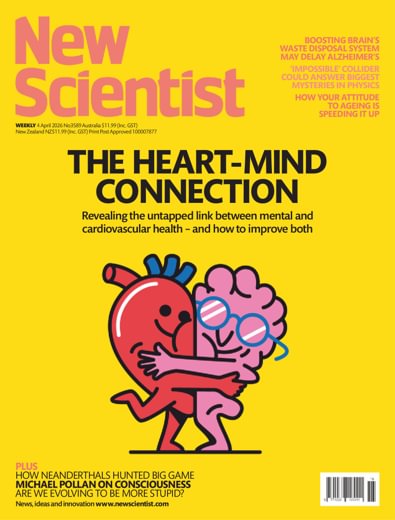
Current Issue: 4 April 2026
Single Issue
Price: $7.99
you save up to 40%
Earn up to 1200 isubscribe Rewards Points, that's 5 points per $1 spent.
This is a digital subscription supplied by Zinio, who will deliver the digital editions direct to your inbox - you can access them directly through your web browser or download the Zinio app on your mobile device. Which devices can I read on?
For people who ask why
New Scientist covers the latest developments in science and technology that will impact your world. New Scientist employs and commissions the best writers in their fields from all over the world. Our editorial team provide cutting-edge news, award-winning features and reports, written in concise and clear language that puts discoveries and advances in the context of everyday life today and in the future.
Be the first!
& get $5 off your next purchase
Be the first person to tell us what you think about New Scientist Australian Edition and you'll save $5 on your next purchase!
In This Issue:
The war on food
WHERE does your food come from? The supermarket or a local farm, you might think, or maybe you even grow your own. But really the answer is fossil fuels – and thanks to the ongoing Iran war, you are going to start noticing that.
Some of the hydrogen atoms in your food actually derive from the natural gas used to make nitrogen fertilisers, for example. Many of the sulphur atoms will also come from fossil fuels – that’s what sulphur fertilisers are made from. Diesel almost certainly powered the tractors of the farmers who grew your food and the trucks and ships that transported it to you. The pesticides that the farmers used were made from fossil fuels, as was the plastic packaging that the food came in. The list…
Cystitis or tooth decay could raise dementia risk
While boosting the brain’s wastedisposal system may delay the onset of Alzheimer’s (see main story), we are also learning what raises our risk of dementia.
In 2021, Pyry Sipilä at the University of Helsinki and his team noticed that those hospitalised with severe infections were more likely to develop dementia.
To find out more, they analysed the health records of 62,555 people aged 65 or over who were diagnosed with dementia between 2017 and 2020. These people were compared with another 312,772 individuals without dementia, whom the team matched for age, sex, education level and marital status. For all participants, the team tracked any diagnoses and hospitalisations that had occurred over the previous two decades.
They identified 29 conditions that were associated with at least a 20 per cent higher risk…
Drugs rid brain of Alzheimer’s proteins
A DUO of drugs that boost our brain’s waste-disposal system so it can better remove proteins associated with Alzheimer’s disease have been identified for the first time. The combination of a therapy that is commonly used as a sedative with a medicine that prevents dangerously low blood pressure seems to safely and effectively remove proteins linked to the disease, which could delay its onset by seven years.
“This is a significant step forward. Even for healthy people, maybe it could maximise brain function” “This is a significant step forward,” says Shiju Gu at Harvard University, who wasn’t involved in the research. “It could benefit people with neurodegenerative disease, but even for healthy people, maybe you could use it to maximise the function of the brain.”
Our brain removes metabolic waste…
Sperm whales help each other give birth
A CALVING sperm whale has been assisted by 10 other females in her social unit – the first time such an event has ever been observed in non-primates.
In July 2023, scientists who have been monitoring a group of sperm whales in the Caribbean since 2005 noticed that all 11 females in the group had gathered near the surface. By chance, the researchers had drones in the air and were able to observe and record the event.
Shortly afterwards, the flukes of a calf started emerging from its mother. The delivery took place over the next half hour, during which time the other females coordinated themselves into a highly synchronised formation to protect the mother and newborn (Science, doi.org/qw88).
As soon as the calf was born, the female whales gathered…
Magnets may offer best asteroid defence
WE COULD deflect potentially hazardous asteroids by using an enormous magnet to gently pull them apart. This idea avoids some of the pitfalls of the traditional kinetic impactor method, which involves smashing something into an asteroid to move it.
The idea is called non-contact orbital velocity adjustment, or NOVA, and Gunther Kletetschka at the University of Alaska Fairbanks presented it at the Lunar and Planetary Science Conference in Texas on 17 March.
In his calculations, he applied the NOVA concept to an asteroid called 2024 YR4, which briefly seemed like it might be on a trajectory to hit Earth or the moon in 2032. The asteroid is small, less than 70 metres across, so it would present a relatively simple target to shift.
The spacecraft itself would consist of a…
A quantum way to take the temperature
A BETTER, more reliable definition of temperature could come from a quantum device full of giant atoms.
While some countries measure temperature in Celsius and others use Fahrenheit, physicists everywhere use a unit called kelvin. Zero kelvin denotes the absolute coldest temperature allowed by the known laws of physics, so kelvin is said to measure “absolute temperature”. In practice, however, it is a laborious process to ensure that when you measure a single kelvin, it really is a single kelvin.
“If you want to make an absolute temperature measurement, you buy a commercial temperature sensor, which was calibrated by another commercial temperature sensor, which was calibrated by another commercial temperature sensor, and so on. And one of those sensors was, at some point, sent to the National Institute of Standards…
AI data centres could warm surrounding areas by up to 9.1°C
DATA centres built to power AIs produce so much heat that they can raise the surface temperature of the land around them by several degrees – creating socalled data centre heat islands that may already be affecting up to 340 million people.
The number of data centres built around the world is forecast to rise enormously. JLL, a real estate company, estimates that data centre capacity will double between 2025 and 2030 – with AI expected to account for half that demand.
Andrea Marinoni at the University of Cambridge and his colleagues saw that the amount of energy needed to run a data centre had been steadily increasing of late and was likely to “explode” in the coming years, so wanted to quantify the impact.
The researchers took satellite measurements…
Male G-spot isn’t where we thought it was
A DETAILED neuroanatomical study of the penis has found that its primary erogenous zone is the frenular delta, an area that has long been left out of anatomy textbooks. The triangular-shaped zone is located on the ventral side, or underside, of the penis, where the head meets the shaft, and may be damaged by circumcision.
“Although this may seem self-evident to anyone attuned to the sensations of their penis during sexual activity, our work scientifically validates the existence of a ventral penile anatomical region that serves as a centre of sexual sensation,” write the authors of the study, led by Alfonso Cepeda-Emiliani at the University of Santiago de Compostela in Spain.
Based on this, the frenular delta should be considered the “male G-spot” of the penis, says Eric Chung at the…
Genetic clues tell the story of Neanderthals’ decline
While Neanderthals were skilled hunters (see main story), DNA analysis has shown what may have ultimately defeated them.
The Neanderthals disappeared from the archaeological record about 40,000 years ago. Late Neanderthals, meaning those who lived after about 60,000 years ago, were genetically similar to each other and different from those who came before – suggesting population turnover.
To find out more, Cosimo Posth at the University of Tübingen in Germany and his team obtained DNA from 10 Neanderthals from six sites in Belgium, France, Germany and Serbia. In each case, they sequenced the mitochondrial DNA, which is inherited only from the mother. They compared the new mitochondrial genomes to 49 that had already been read.
Almost all Neanderthals who lived between 60,000 and 40,000 years ago belonged to the same lineage,…
Going on the hunt with Neanderthals
IN THE backrooms of the sleek, modern Schöningen Research Museum in Germany, there are piles of old, mismatched cardboard boxes everywhere. These are the finds boxes from Lehringen, a hamlet 150 kilometres from here.
“We found some cut marks that were super clear. It’s almost difficult to imagine that nobody noticed them” In 1948, the bones of a 125,000-year-old straight-tusked elephant (Palaeoloxodon antiquus) were found in an ancient lakebed at Lehringen. Elephant bones from this time period are not so rare, but this one had a 2.3-metre-long spear sticking between its ribs.
This yew thrusting lance was then the oldest complete spear ever found. (A part of a spear from an earlier period had previously been found in Clacton-on-Sea in the UK.) The Lehringen spear is still the only one…
Prev
Next
https://www.isubscribe.com.au/new-scientist-australian-edition-digital-subscription.cfm
35955
New Scientist Australian Edition
https://www.isubscribe.com.au/images/covers/au/5254/35955/square/NewScientistAustralianEdition44202631825.jpg
7.99
AUD
InStock
/Digital/Science & Nature/Environment
For people who ask why
7.99