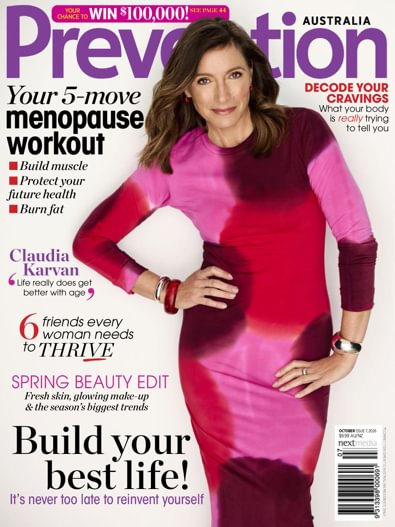
Prevention Magazine Australia digital subscription
Current Issue: October 2026
Single Issue
Price: $6.00
you save up to 13%
Earn up to 210 isubscribe Rewards Points, that's 5 points per $1 spent.
This is a digital subscription supplied by Zinio, who will deliver the digital editions direct to your inbox - you can access them directly through your web browser or download the Zinio app on your mobile device. Which devices can I read on?
Packed with inspiration and motivation, Prevention magazine makes living a healthier lifestyle easier than you ever thought possible. Its unrivalled credentials make it your go-to for breakthrough health news and views you can trust. You’ll find the best expert advice, stories from inspiring real women, and easy, actionable tips on weight loss, fitness, nutrition, health, your mind and anti-ageing beauty. It’s also the destination for nutritious and delicious recipes.
Be the first!
& get $5 off your next purchase
Be the first person to tell us what you think about Prevention Magazine Australia and you'll save $5 on your next purchase!
In This Issue:
It’s time to put menopause front and centre.
YOU CAN HELP OWN THE CONVERSATION AROUND MENOPAUSE BY:
SPEAKING UP ON YOUR OWN TERMS
Talk about menopause with friends, family and health professionals. Saying it out loud takes away the stigma.
ASKING FOR WHAT YOU NEED AT WORK
Push your workplace to catch up – flexible policies, open dialogue and managers who understand.
KNOWING THE FACTS AND TRUSTING THEM
Know the facts, question what doesn’t sound right and expect your GP to take your symptoms seriously.
LEADING THE WAY IN YOUR COMMUNITY
Bring people together – host an event, start a walking group or simply make your community a place where women can talk.
LEARN MORE AT worldmenopauseday.com.au
#OWNTHECONVERSATION…
Spring in your step
I’m calling it: the ugg boots are going back into storage, the flannelette sheets have been swapped for crisp cotton ones, and the sandals are being dusted off. Yep, winter (such that it was) is over and spring is upon us!
If the sandals part of that equation has you looking down at your tootsies in terror, I can hard relate – my crusty heels have become part of family folklore. (Read: My teenage kids tease me about them mercilessly. I’ve threatened to use my heels as assault weapons – and frankly, they could do some damage!) Suffice to say, I was quick to agree to our beauty feature ‘Putting in the leg work’ (page 36), which not only takes care of your feet, but everything from the knees down.…
We asked, you answered
Q WHAT HELPS YOU SLEEP BEST?
41% Reading before bed
15% No screen time before bed
21% WARM BATH OR SHOWER
23% A COOL, DARK ROOM
Q IF YOU COULD ONLY DO ONE WORKOUT FOR A MONTH?
40% WALKING
31% Strength training
5% CYCLING
24% Yoga/Pilates
Q YOUR BIGGEST SKINCARE GOAL?
30% Brighter skin
15% SMOOTHER SKIN
5% CLEARER SKIN
50% Firmer skin
Q YOUR FAVOURITE STRESS RELIEVER?
46% TIME ALONE
5% Music or podcasts
27% GETTING OUTDOORS
22% Exercise
*Results sourced from polls conducted on Prevention’s Instagram @preventionaus…
TRY SOME SONIC CAFFEINE!
Forget your morning coffee… there’s a new way to start your day: ‘sonic caffeine’. Loosely translated, it means playing tracks that wake you up and make you feel good. A growing number of streaming services are using cognitive science to create music designed to help us wake up and focus. Among them is Sollos (findsollos.com), which works with Apple Music (so you’ll need a subscription) to create alternative versions of songs by artists including Ariana Grande, Katy Perry and Olivia Dean.
“Music directly influences the brain’s reward, emotion and autonomic regulation circuitry,” says Universal Music Group’s director of cognitive science research, Tara Venkatesan. “It’s one of the few everyday experiences that can change how we feel within minutes.” In UMG’s research, listening to a Sollos track for 30 minutes was…
Health
ROUTINE CHECK
Middle-aged adults who follow regular daily routines may age more slowly, according to a study in JAMA Network Open. After tracking participants’ activity, sleep and sedentary behaviour for seven days, researchers found that those with more consistent routines and a clearer distinction between daytime activity and night-time rest had lower biological age scores than those with more fragmented routines. This adds to growing evidence that maintaining consistent sleep and activity patterns helps regulate the body’s circadian rhythm – or internal 24-hour clock – which plays an important role in physical, mental and brain health. The study authors plan to conduct clinical trials to investigate whether improving daily routines could help slow biological ageing.…
Brain wash
Yawning in a meeting or when your friend is sharing an emotional story might be embarrassing, but UNSW Sydney scientists say this long-misunderstood primitive reflex could serve an important purpose. By moving cerebrospinal fluid and venous blood out of the skull, a good yawn may help clear waste from the brain and regulate its temperature. Both these mechanisms could help support brain health and reduce the risk of neurodegenerative conditions such as dementia and Parkinson’s disease, but more research is needed to confirm this theory. Until then, stop stifling your yawns!
Sun smarter
Spending short amounts of time outdoors early or late in the day can still cause sun damage, a landmark QIMR Berghofer study has found. Challenging long-held beliefs, these findings suggest sunscreen is necessary any time we step…
What’s up with… Frozen SHOULDER
You reach to grab a jumper from a high shelf and – yowza! – you feel a jolt so sharp you see stars. Welcome to frozen shoulder (FS), which causes pain and stiffness that often lasts more than a year. About one in 20 people may experience FS as they age, with women a bit more at risk than men.
What causes the pain?
FS happens when the lining of the shoulder joint – the tissue that surrounds the bones – becomes inflamed, thick and scarred. Your shoulder could freeze after surgery on your chest or spine, but often there is no obvious trigger. “A minor shoulder injury that you didn’t even notice could set off a cascade of inflammation,” says orthopaedic surgeon Dr Laura Moore. The drop in oestrogen…
Yes, we ARE hormonal!
As a consultant endocrinologist, if there’s one phrase I’d like to challenge, it’s ‘You’re so hormonal!’ Apart from doing a disservice to women, it assumes that hormones are only responsible for our negative behaviours and experiences, when in fact they animate every aspect of our lives, defining our very idea of what normal life feels like.
Aside from the big-ticket life events, day to day, minute to minute, our hormones control our daily energy levels; how we cope with stress, from a rush-hour traffic jam to a broken heart; whether libido is flourishing or going through a fallow patch; the weight flashing up on the bathroom scales; and the amount we need to eat to feel full. There’s this incredible communication system in the body that ties it all together.…
Fitness
BUILT TO LAST
Staying strong may help women live longer, according to a US study. Participants with stronger muscles – as measured by their dominant hand grip strength and how quickly they could repeatedly get up from a chair without using their hands – had a lower risk of death even when they didn’t meet recommended levels of aerobic activity. A separate study in the Journal of Sport and Health Science found that strenuous training and muscle soreness aren’t necessary to improve muscle size or strength. Simple, equipment-free exercises that focus on the lowering part of movements, such as chair squats, heel drops and wall push-ups, can build stronger muscles and improve health in as little as five minutes a day. Too easy!…
Worn thin
With around 90 per cent of Australian women donning activewear for more than just exercise, there’s an assumption that slipping into workout gear will make us feel stronger, fitter and more confident. But new Edith Cowan University research suggests it’s not that simple. While women who bought, wore or engaged more on social media with activewear tended to exercise more, they were no more likely to have higher self-esteem or body confidence. In fact, almost one in three admitted feeling self-conscious while wearing it. It seems confidence isn’t something you can simply pull on with a pair of leggings.
Gutsy moves
Training harder could improve your gut health, say Edith Cowan University scientists. They found that intense workouts changed the balance of bacteria and crucial compounds in athletes’ digestive systems…
Prev
Next
https://www.isubscribe.com.au/prevention-magazine-australia-digital-subscription.cfm
38536
Prevention Magazine Australia
https://www.isubscribe.com.au/images/covers/au/5254/38536/square/PreventionMagazineAustralia69202621042.jpg
6.00
AUD
InStock
/Digital/Health & Fitness/Spa & Wellness
6.00