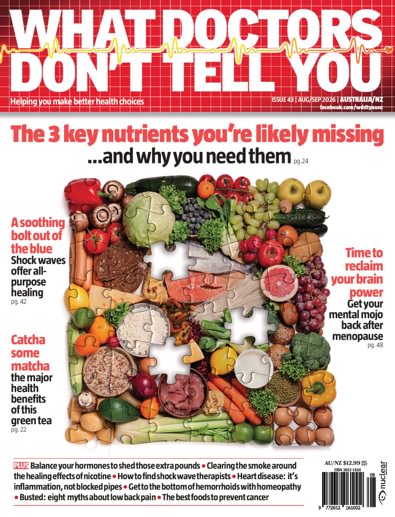
What Doctors Don't Tell You Australia/NZ digital subscription
Current Issue: August - September 2026
Single Issue
Price: $5.49
you save up to 21%
Earn up to 130 isubscribe Rewards Points, that's 5 points per $1 spent.
This is a digital subscription supplied by Zinio, who will deliver the digital editions direct to your inbox - you can access them directly through your web browser or download the Zinio app on your mobile device. Which devices can I read on?
Helping you make better health choices
What Doctors Don’t Tell You is a bi-monthly magazine which publishes the latest healthcare news, alongside information on complimentary therapies and alternative medicines, with a host of features and stories written by leading experts and our highly-respected regular contributors. We aim to bring our readers world-leading research and ground-breaking news. Our hallmark is in-depth research, and hard-won information of a quality that can change lives for the better.
Be the first!
& get $5 off your next purchase
Be the first person to tell us what you think about What Doctors Don't Tell You Australia/NZ and you'll save $5 on your next purchase!
In This Issue:
GETTING A TUNE-UP
O fall the alternative treatments out there, one of the most unlikely is shock wave therapy, for a simple reason: It uses sound waves to heal.
Until now, sound has been the Cinderella of energy in medicine, unleashed when some sort of force causes a vibration, creating a pressure wave through air or water. Since this energetic output is far lower than all other energies, its purposes have been understood to be limited largely to communication or entertainment.
But recently scientists have been experimenting with sound as a healing agent. Sound waves are measured in Hertz, the speed at which a sound wave, represented as a sideways S, completes one full cycle of amplitude up and down.
Decades ago, doctors began using sound waves to break up kidney stones and…
EDITORIAL PANEL
Dr Damien Downing, MB BS, MRSB, who practices ecological medicine, is president of the British Society for Ecological Medicine, former editor of the Journal of Nutritional and Environmental Medicine and an editorial board member of Orthomolecular News Service. The author of five books, including Coherent Health, he lectures widely for the British Society of Environmental Medicine.
Bruce Lipton, PhD, is an internationally recognized leader in bridging science and spirit. Stem cell biologist, bestselling author of The Biology of Belief and recipient of the 2009 Goi Peace Award, he has been a guest speaker on hundreds of TV and radio shows as well as a keynote presenter for national and international conferences.
Dr Sarah Myhill has worked in the UK National Health Service and in private practice since 1981. Honorary Secretary…
UPFRONT
Drink more tea after menopause
If you’ve been through menopause, start drinking more tea—and cut back on the coffee. Teas contain catechins, natural polyphenols that strengthen bones as we age and reduce the risks of fracture and osteoporosis.
Women who drink plenty of tea every day have stronger bones, but bone health deteriorates in women who drink more than five cups of coffee a day.
Researchers at Flinders University in Australia tracked the bone health of nearly 10,000 women aged 65 years or older to discover whether tea or coffee had any impact on bone mineral density (BMD), which can deteriorate after menopause. Osteoporosis affects one in three women over the age of 50, and it can result in easy fractures.
Regular tea drinkers had slightly improved BMD, but this…
Heart disease: more inflammation and less blocked pipes
No, it’s not breast cancer: The number one killer of women is heart disease, but you might not recognize it as such because it doesn’t follow the classical pattern. For women, a heart attack (myocardial infarction) is often nothing to do with a blocked artery; their arteries are completely clear, and yet they still suffer a heart attack.
They also don’t always suffer the usual symptoms of a heart attack. Sometimes there’s not a crushing feeling in the chest or sensations down one arm, and yet a heart attack it is.
The same is true for men, but to a lesser extent. Around a third of men have a heart attack that’s nothing to do with a blocked artery restricting the oxygen supply to the heart, and again their symptoms…
Busted: eight myths about low back pain
There are eight major myths about back pain that Meghan Murphy, a neurosurgeon at the Mayo Clinic Health System in Mankato, Minnesota, has busted.
1 Myth: Lifting heavy objects is the main cause of back pain
Fact Poor form during lifting can contribute to back pain, but the major culprits are a sedentary lifestyle, poor posture, obesity and genetic factors.
2 Myth: Bedrest will make back pain better
Fact It depends on the cause of your pain, but bedrest is unlikely to help. If it’s muscle strain, taking it easy for a few days may bring relief.
However, bedrest can also prolong or worsen back pain. If your pain is due to nerve compression, a disc issue or joint degeneration, inactivity can cause more problems, like tighter muscles, worse pain, and a…
Catcha matcha
The smart folk drink green tea, but the super smart choose matcha. Matcha is a type of green tea, but it’s processed differently, which makes it richer in health-giving antioxidants.
Matcha is a finely ground green tea powder made from Camellia sinensis leaves. Unlike regular green tea, whose leaves are steeped and discarded, matcha uses the entire powdered leaf, giving the drink a higher concentration of caffeine and antioxidants.
The tea is also rich in chlorophyll, an antioxidant that has cancer-fighting qualities, and L-theanine, an amino acid that promotes relaxation, improves sleep quality and enhances focus. It also contains lutein and vitamin K, which could help the elderly remain cognitively sharp, and its catechins, particularly epigallocatechin gallate (EGCG), can lower the risk of heart disease.
Its advocates would say that,…
THE NUTRIENTS WE QUIETLY LOST
Most of us assume that if we’re eating reasonably well and our blood tests come back “normal, ” we’re probably doing fine nutritionally. No red flags. No deficiencies.
We may feel less than brilliant—tired, foggy, slower to recover, maybe less able to cope with physical or emotional stress than we used to be. But our doctors aren’t worried if our test results are reassuring.
At the same time, troubling trends persist at the population level. Birth defects have not disappeared. Children today suffer from far more chronic illness than their grandparents did.
Inflammatory disease is epidemic. Infertility continues to rise worldwide. More people are anxious and depressed than ever before. Dementia is a huge and growing crisis, and cancer still has not been beaten.
If we’re so well fed and…
Choline for baby’s brain
The impact of choline stretches across the lifespan, but demand for it soars during pregnancy because it is critical to fetal development. An active choline shunt develops from a mother to her unborn baby, who has choline concentrations 15 times that of a grown adult during brain development, membrane formation and more.
Ongoing studies from Cornell University’s Choline Cognition Research Group show just how critical choline input is to brain development. One experiment randomized pregnant women into groups receiving either 480 mg/day (about the current recommendation) or 930 mg/day of choline throughout the third trimester of pregnancy. Infants born to mothers in the higher-choline group showed faster information processing speed (a key early marker of neurocognitive function) when tested between four and 13 months of age.1
A follow-up of these…
What taurine can do
Last year, a meta-analysis of 34 randomized controlled trials found that taurine supplementation improved fasting blood glucose and insulin sensitivity, lowered blood pressure and total cholesterol, and reduced inflammatory markers linked to cardiometabolic disease.1
This confirms earlier research:
• Populations that have the highest taurine intake, such as the Japanese, also have the lowest rates of heart attack.2
• Taurine supplementation lowers blood pressure and improves blood vessel function.3
• Higher taurine levels are associated with a 26 percent lower risk of developing Alzheimer’s.4
• Taurine supports eye health, and supplementation can help to relieve visual fatigue.5
• Taurine protects skin from stress-related aging.6
REFERENCES
1 Nutr Rev, 2025; doi:10.1093/nutrit/nuaf220
2 Adv Exp Med Biol, 2009; 643: 13–25
3 Hypertension, 2016;67(3):541–9
4 Alzheimers Dement,2017;13(12): 1327–1336
5 Nutrients, 2023;15(8):1843
6 Cells,…
Heal fast with glycine
“Glycine is the trigger lock on the immune system,” says Dr Joel Brind. He arrived at this conclusion after experimenting on himself.
After decades of studying amino acids in the lab, he began supplementing 10 g of glycine daily in 2008, figuring that at the very least it could do no harm. “I don’t believe you can overdose on glycine,” he says.
About two years into this experiment, he went to an open-air New York Yankees baseball game in full sun. Since the Yankees were winning, Brind didn’t realize until the fifth inning that his skin had become bright red with sunburn.
Based on past experience, he expected days of pain followed by blistering, crinkling and peeling skin. None of that happened. The redness faded. The skin tanned. There was…
Prev
Next
https://www.isubscribe.com.au/what-doctors-dont-tell-you-australia-nz-digital-subscription.cfm
39960
What Doctors Don't Tell You Australia/NZ
https://www.isubscribe.com.au/images/covers/au/5254/39960/square/WhatDoctorsDontTellYouAustrali277202621210.jpg
5.49
AUD
InStock
/Digital/Health & Fitness/Spa & Wellness
Helping you make better health choices
5.49