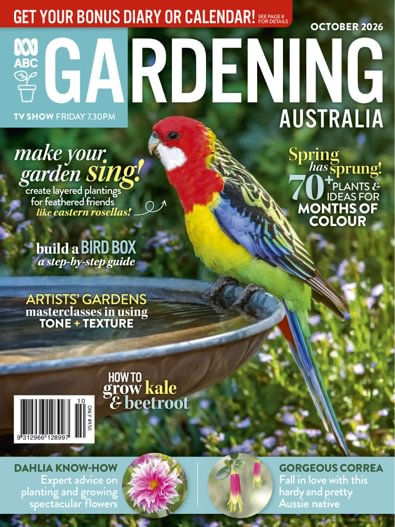
Gardening Australia magazine subscription
Cover
Price: $9.50
you save up to 17%
Australia’s leading gardening title, this is the ultimate bible for any gardening enthusiast. With expert planting and garden advice, from urban courtyards to country estates – every issue will inspire.
Read more
Deliver to:
Earn up to 475 isubscribe Rewards Points, that's 5 points per $1 spent.
RRP
$28.50
$26.99
SAVE 5%
RRP
$57.00
$52.99
SAVE 7%
RRP
$114.00
$94.99
SAVE 17%
Earn up to 825 isubscribe Rewards Points, that's 5 points per $1 spent.
Digital subscriptions are available for this title. Digital Subscriptions are supplied by Zinio, who will deliver the digital editions direct to your inbox - you can access them directly through your web browser or download the Zinio app on your mobile device.
VIEW DIGITAL SUBSCRIPTIONS
Whether you’re a gardening novice or a well-seasoned green thumb, Gardening Australia will have you itching to get out there in the garden.
Packed with expert step-by-step advice complete with pictures and planning ideas, this is your blueprint for creating a flourishing garden or transforming your outdoor space.
You’ll find everything you need to know about gardening from climates and soil, to different plants, trees, shrubs and flowers, to growing your own fruit and vegies; check out clever ways to plant – creating colour, tone, depth and contrast and use our monthly planner to plant around the seasons. Plus you’ll find all the top tips from the TV show from water-saving and organic ideas to bright, new products and inspiring people and places.
So grab your gardening gloves and get cracking.
From the publisher
Whether you’re a novice or an experienced gardener, ABC Gardening Australia magazine is packed with expert step-by-step advice and stunning design ideas for every gardener across the country.
Subscribe today and get every issue conveniently delivered free to your door!
All prices for magazine subscriptions listed on isubscribe include delivery.
Your subscription will begin with the next available issue and in most cases, your magazine will be in your hands before it goes on sale in the shops! Due to publishing cycles and potential delays with Australia Post, please allow up to 4-7 weeks for your first delivery to arrive.
Gardening Australia is published by
Next Media,
who handle delivery and stipulate the lead time shown above.
Explore more titles from this publisher here.
In This Issue:
EDITOR’S LETTER
Like many people, I’ve had eastern rosellas on my mind recently. While I’m weeding. While I’m re-potting plants. On the bus to work. Day and night. It usually starts as an innocent hum and, before I realise it, those birds are fluttering around in my brain for another day. Don’t know what I’m referring to? Then you haven’t heard the catchy Eastern Rosellas tune and earworm which recently took flight and became a surprise hit of the season (read a little more about that on page 12). Needless to say, when it came to choosing our cover this month to promote bird-friendly gardens, an eastern rosella was a popular choice. Look at those beautiful colours!
Hearing birdsong is one of the beautiful things about being out in the garden. To…
October
THE COUNT IS ON
The Aussie Bird Count takes place from October 19 to 25, and gardeners everywhere have a front row seat to the action. By monitoring feathered friends (such as this New Holland honeyeater, left) visiting your backyard or balcony, you can help create a broader picture of how bird populations are faring. For more, turn to page 71. aussiebirdcount.org.au
For more news and events, see over the page.
Miles of Rosellas!
For weeks, the world has been joyfully singing about our fluoro-coloured birdlife, thanks to the viral hit Eastern Rosellas, written and performed by seven-year-old Sydneysider Miles Phillips and his dad Joel (right). The catchy tune and persistent earworm has thrust these birds into a deserved spotlight. Go, Miles! Eastern rosellas are found across south-eastern…
PLANTS
Looking to grow your own produce year-round? The Diggers Club’s Ultimate Year Long Harvest Collection (above) comprises 18 different seed packs, running from beans to zucchini. So whether you’re planting up a balcony container, raised bed or garden plot, you can have seasonal ingredients for salads or stir-fries at your fingertips. diggers.com.au
The dainty lilac flowers of Merck’s dahlia (Dahlia merckii, above) are a relatively rare sight in Australia, but this tuberous-rooted perennial is worth searching out. Native to Mexico, it is hardy in cold conditions and can be left in the ground once the tops have died down. Just make sure the tubers are in free-draining soil and well mulched. Plant in a sheltered spot in full sun, and you’ll be rewarded with pretty blooms atop tall (about 1m…
BOOKS
THE PRODUCTIVE GARDEN COMPANION
Natasha Morgan, Murdoch Books
The fire pit and verge garden outside Natasha Morgan’s home in Daylesford, Victoria, say a lot about her generosity. In this book, the landscape architect, gardener and educator shares not just expert guidance, but her own story. Full of practical advice on everything from garden design and growing to building soil and raising chooks, the book also offers deeper wisdom. Some examples: garden planning is ‘a steady accumulation of understanding’; ‘compost is transformation made visible’; ‘harvest because it steadies you, not just because it’s ripe’. Further insights come from conversations with fellow growers and designers, case studies and QR codes linking to other content.
WHAT THE FLORA?
Vanessa Fuchs, Pantera Press
In January 2025, Royal Botanic Garden Sydney’s corpse flower ‘Putricia’ bloomed.…
EPIC canvas
Artist and garden designer Ralph Bristow approaches his garden much like a painting. He regards the landscape as a large canvas that he transforms in an arrangement of colour and texture – a flowing palette of diverse plants with high and low notes, movement and strong form. But while a painting captures a moment in time, a garden is constantly evolving. “The garden is dynamic, and changing all the time with the seasons,” Ralph says.
His garden, The Barwitian Garden, is on Taungurung Country, at Barwite, near Mansfield, in north-east Victoria. Covering more than a hectare beside the Broken River, it showcases perennials, grasses, succulents and trees laid out in painterly swathes. It’s been described as naturalistic – or, as Ralph says, “a wild orchestra of plants, insects and birds”…
RIPPLE EFFECT
“PLANTS AND WILDLIFE HAVE ALWAYS BEEN CENTRAL TO MY ART AND PROFESSIONAL LIFE.” Jasmine Jan woke up to the sound of pelicans one morning in August 2025, leaving her wondering what these shorebirds were doing in her Top End garden in Lambells Lagoon. She was used to a cacophony of bird sounds in the garden, but never pelicans. More commonly found on the coast and in large, open bodies of water, they had come to feed in the paperbark billabong overlooked by Jasmine’s art studio. That morning, they joined the chorus of other native birds that inhabit this seasonal flooded forest, a natural feature of the 40ha bush block Jasmine and her husband, Mark, bought 20 years ago, 40km south-east of Darwin, on Larrakia Country.
At the start of the…
dreamy
DAHLIAS
For anyone keen to bring colour and excitement to the garden through the warmer months, dahlias could be the plants you’re looking for. They’re easy to grow, there are thousands of varieties to choose from, and they come in a huge range of flower shapes, sizes, colours and petal formations.
Dahlias are all about colour, and they’re available in every hue except blue and green. They range from the palest white to some that are so dark they are called black. There are varieties with several colours in each bloom, including the stunning ‘Show and Tell’ (a huge red flower with yellow tips), and the more sedate ‘Wine and Roses’, which has pink-to-white flowers tipped with purple.
One of the most popular dahlias globally is ‘Café au Lait’, which produces,…
tubular belles
Correas may not be the flamboyant, look-at-me darlings of the garden, but these quiet achievers more than compensate with their versatility, resilience and wildlife value. True garden workhorses, they grow happily in sun or shade, and are suitable as informal hedges, border and understorey plants, leafy backdrops, rockery features, groundcovers and pot specimens. They are also mainstays of coastal and habitat plantings, where they provide the essential mid-layer that supports many of our smaller bird species.
Correas range from prostrate forms, such as spreading correa (C. decumbens), to the upright mountain correa (C. lawrenceana), which can reach about 3–4m in cultivation. They occur right across southern and eastern Australia, from temperate to subtropical climates.
Most correas produce small tubular or bell-shaped, nectar-rich flowers in shades of pink, red, orange, yellow,…
ready, set,
grow!
As the days and nights get warmer, gardens are bursting into bloom – and there’s no better time to plant and plan for the colourful months ahead. In these pages, we show you how to plant for continuous colour using familiar favourites, and introduce some lesser-known beauties. Discover tools that will become your best friends over this busy season, how to create abundant pots, and perfect plants for hanging baskets. Whether you’re refreshing a single container or an entire garden, you’ll find plenty of inspiration to keep it flowering and powering through spring.…
seasonal snapshot
CLIMATE: COLD TEMPERATE
HANNAH MOLONEY
ABC Gardening Australia presenter in Tasmania
Location: Hobart/nipaluna
Your key spring tasks? In the vegie garden, we’re planting seedlings of broccoli, Asian greens, salad greens and tomatoes, and sowing seeds of beans and root crops. In the greenhouse, we’re growing zucchini and pumpkins, for planting out in November. In the orchard, we’re applying coddling moth treatment to our apple trees with cardboard collars and horticultural glue on paper tape, and keeping an eye on our nectarine trees for peach leaf curl, a fungal disease, removing any infected foliage.
Describe the seasonal changes in your local landscape: Spring is sometimes called the windy season or ‘sprinter’, as it’s a mix of winter and spring. You have to be careful not to be lulled by an occasional…
Prev
Next
https://www.isubscribe.com.au/gardening-australia-magazine-subscription.cfm
113
Gardening Australia
https://www.isubscribe.com.au/images/covers/au/779/113/square/GardeningAustralia6920262115.jpg
26.99
AUD
InStock
/Magazines/Home & Garden/Gardening
Australia’s leading gardening title, this is the ultimate bible for any gardening enthusiast. With expert planting and garden advice, from urban courtyards to country estates – every issue will inspire.
26.99